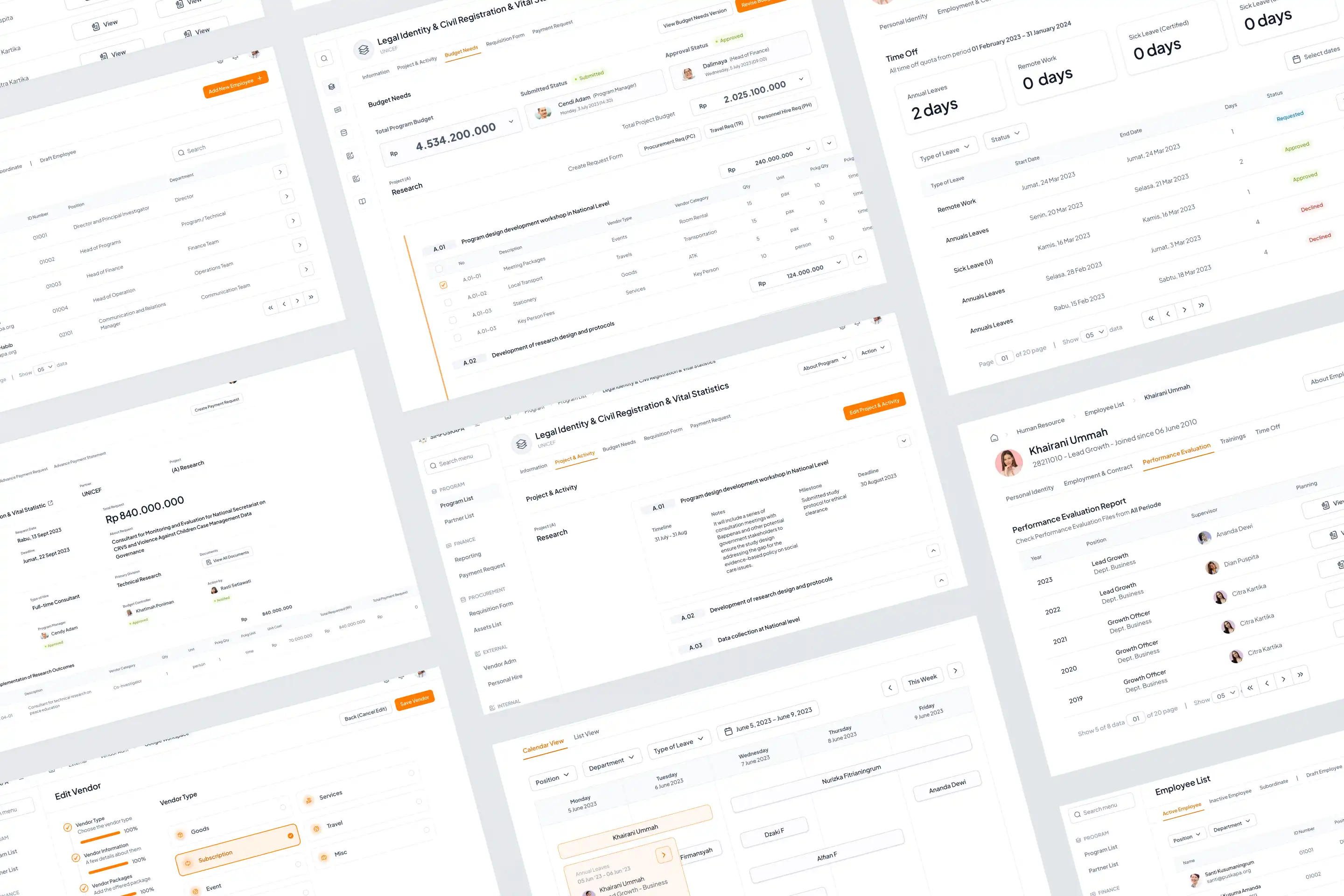
SIMPUSKAPA
Management system that helps users navigate operational processes from human resource, finance and programs.
- Category
- Information System & Digital Platform
- Period
- 2021 – 2026
- Role
- Designer & Project Manager
- Tools
- Figma, Toogl, Notion
Project's Overview
SIMPUSKAPA is a Management Information System for PUSKAPA (Pusat Kajian dan Advokasi Perlindungan dan Kualitas Hidup Anak), a think tank group at Universitas Indonesia.
The project was initiated because PUSKAPA's existing information was not yet sufficiently integrated and centralized, making it difficult to retrieve historical information across a project lifecycle. The proposed system was intended to improve the existing intranet and establish a more integrated information and management system.
The system brings together operational information, project management, budget needs, requisitions, approvals, procurement, personnel, travel, finance, and knowledge management into connected workflows.
Project's Challenge
How might we + help reducing the friction + for + PUSKAPA's internal system + so that + tracking and processing all information, documents, request and approval easily to do
Project Process
The project involved several interconnected processes, where decisions made at one stage could influence subsequent stages. Rather than designing each feature independently, the work focused on understanding how different activities, data, requests, approvals, and financial processes could work together as a coherent system.
The project was carried out through four main phases:
1. Analysis
The first phase focused on understanding the existing system, operational requirements, and the needs of the people who would use the system.
This included reviewing relevant documentation, studying existing processes, and conducting interviews with stakeholders and relevant partners when required. The main objective was to understand the relationships between processes and identify what the system needed to support.
This phase established the foundation for translating operational requirements into a structured digital product, rather than approaching the project as a collection of individual screens or features.
2. Information Architecture & System Flow
The second phase focused on translating the findings from the analysis into the structure and flow of the system.
This included defining the information architecture, relationships between modules, user flows, and the movement of information across different stages of a process. Particular attention was given to ensuring that related processes could remain connected as users moved from one activity to another.
The resulting structure became the foundation for designing the system's navigation, workflows, forms, dashboards, and other interfaces.
3. Implementation
The implementation phase involved translating the defined system structure into a working digital product.
The design was developed in collaboration with the System Analyst and development team, allowing requirements, system logic, and interface design to be considered together. During this phase, the design was also reviewed against implementation constraints and adjusted where necessary.
This collaboration helped maintain alignment between the intended user experience and the system being developed.
4. Testing, Iteration & Collaboration
The final phase focused on validating the system through different user and process scenarios.
Testing was used to review whether the designed flows, information, states, and interactions worked consistently across connected processes. Findings from testing and implementation reviews were documented and used to refine the system.
This phase was iterative, with continuous collaboration between design, analysis, development, and stakeholders. Rather than treating testing as a final step, it became part of the ongoing process of improving and aligning the product.
Results
The resulting system supports several teams involved in PUSKAPA's operational, financial, and program activities:
| Team | Role in the System |
|---|---|
| Operations | Supports procurement, asset management, and operational processes |
| Finance | Manages project-related funds, payments, tax, and financial processes |
| Program | Supports research, field activities, advocacy, and dissemination |
| Management | Reviews and approves projects, budgets, and requests |
The system brings together key areas of organizational management through modules covering Human Resources, Finance, Projects, Budgets, and Procurement.
Beyond providing a centralized place to manage these activities, the system was designed to make processes easier to follow and information easier to trace. Users can track the progression of requests and approvals, while related documents and supporting artifacts remain connected to their respective processes.
The result is a more connected management system that helps users navigate operational processes, follow approval progress, and trace the information and documentation associated with each request.
Roles & Contribution
Team Structure
- Nurizka F - UI/UX Designer & Project Manager
- Khairani U - System Analyst & Project Manager
- Alfian F - Back-end Developer
- Dzaki F - Front-end Developer
Roles
Project Manager & UI/UX Designer
Key Activities
- Led design and front-end aspects of a management information system supporting thousands of participants and billions of rupiah in annual program funding.
- Worked closely with stakeholders to review and improve existing standard operating procedure, translating operational processes into workflows that could be effectively implemented in the system.
- Designed system flows, information architecture, dashboards, and interfaces across Operations, Finance, and Research departments.
- Translated organizational requirements into system modules and user experiences in collaboration with analysts and developers.
- Managed HR, Vendor, Programs & Budget, Procurement, Finance, and Asset modules, ensuring they remained aligned with operational processes
Learning & Takeaway
From a product perspective, the project resulted in more than a collection of administrative modules. It established a connected workflow in which information, requests, approvals, and supporting artifacts could be managed as part of the same system. This required aligning the user experience with the underlying operational flow and collaborating across design, analysis, development, and stakeholder review.
Competencies-related to this Project
- Product & Project Management — Requirements analysis, stakeholder collaboration, process alignment, backlog management, and implementation review.
- Experience Design — Information architecture, system flows, dashboards, forms, approval flows, and iterative testing.
- Digital Product Development — Designing connected modules and workflows across HR, projects, budgets, procurement, and finance.
- Technology Collaboration — Working with system analysis and development roles to translate operational requirements and designs into an implementable system